The Dead-End Handoff: Why Most AI Support Tools Still Drop the Customer
Quick answer
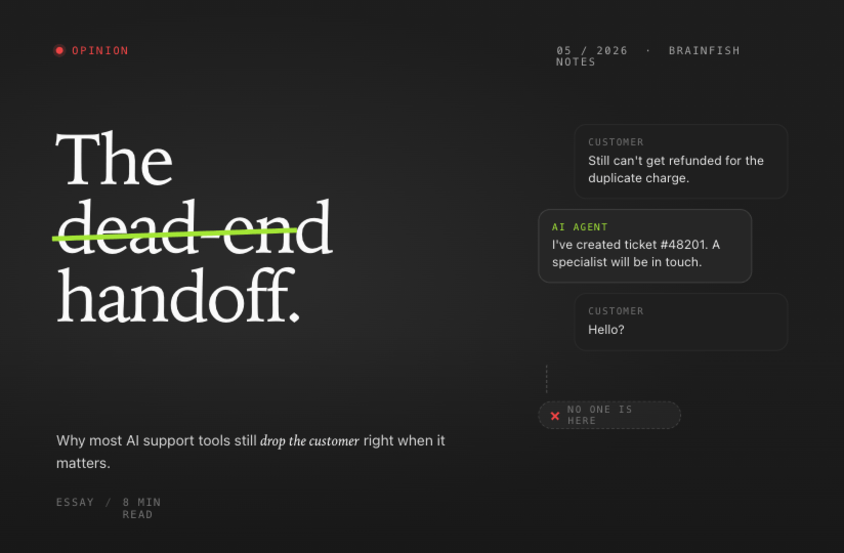
The dead-end handoff is the most consistent failure mode in 2026 AI support: when the AI cannot resolve a customer's question, the customer asks for a human, gets dropped into a ticket queue, loses all the context they shared with the AI, and starts from zero with a human agent who starts blind. CSAT on these escalated conversations sits 15 to 25 points below CSAT on AI-resolved or human-only conversations, not because the AI failed at the resolution but because the handoff itself was the damaged moment. The structural fix is to make the handoff a continuation rather than a restart: the customer stays in the same window, the agent inherits the full AI conversation with retrieved sources and confidence trajectory, and the resolution picks up at minute six instead of minute zero. Brainfish Live Agent Handoff for Zendesk shipped this week as the first generally-available implementation of that pattern. This essay argues that the dead-end handoff is structural, not a feature gap, and that 2026 is the year AI support teams stop accepting it.
The pattern
Every support leader running AI in production knows this conversation. The AI handles the first half. The customer asks for a human. The transfer happens. A few minutes later, the support leader gets a screenshot of the agent's first message to the customer: "Hi, I see you reached out about an issue. Could you describe what's happening?"
The customer has already described it. Three times. To the AI. The AI knew the customer's name, the product version, the error message, the time the problem started, and the customer's frustration level. None of that made it to the agent. The agent starts blind and the customer starts angry, and the second half of the conversation is now adversarial because the customer is re-explaining context that should have arrived with the transfer.
This happens, in some form, on every major AI support deployment we have looked at. The frequency varies (handoff rates range from 15% to 40% depending on product complexity), but the pattern is consistent: when escalation happens, the experience degrades sharply, and not because the human is bad at the resolution. The handoff itself is what damaged the conversation.
Third-party CSAT data backs up the pattern. Escalated conversations consistently score 15 to 25 points below AI-resolved or human-only conversations across the deployments we have measured. The escalation is not a neutral event; it is a CSAT-negative event, even when the eventual resolution is correct.
Why this is structural, not a feature gap
The natural response when a team notices the dead-end handoff pattern is to ask the AI vendor to "fix the handoff." Most vendors interpret this as a feature request: add a "transfer to human" button, route the ticket faster, attach a summary to the new ticket. These are real improvements and they do not solve the structural problem.
The structural problem is that the AI conversation and the human conversation are different surfaces. The AI runs in a widget or a chat surface. The human conversation runs in a helpdesk ticket. When the customer escalates, they are switching surfaces. They are entering a new system. The context lives in the old system. The new system asks the customer to re-explain because the new system has no idea what the old system knew.
This is not a feature gap. It is an architectural mismatch between the AI surface and the human-agent surface. The fix is not to bolt a better summary onto the ticket. The fix is to make the AI conversation and the human conversation the same conversation, on the same surface, with the same context, from the customer's perspective.
Four properties define a real handoff:
- The customer stays in the same conversation window. No new ticket. No new tab. No "please hold while we transfer you."
- The agent inherits the full AI exchange. Every message, every retrieved source, every confidence score, every action the AI attempted. Not a summary. The actual conversation.
- The handoff trigger is configurable based on the customer's explicit request, the AI's confidence trajectory, or a specific intent that should always go to a human (billing disputes, account closures, etc.).
- The handoff event is structured data, not a free-text note on a ticket. The team can analyze handoff cohorts in reporting, the content team gets a signal that the AI lacked coverage, and the support leader can answer "how are our handoffs trending" with data.
Without these four properties, the handoff is still a dead end. With them, the handoff becomes a continuation.
What good looks like
When the handoff works structurally, three things change immediately and one thing changes over time.
Immediately, the customer experience stops degrading at the moment of escalation. CSAT on handed-off conversations recovers the 15 to 25 point gap because the customer no longer feels like they restarted. The agent's first message can be specific and contextual rather than generic, which is the moment trust gets rebuilt: "I can see you've been working with our assistant on the Zoom integration issue. Let me check what's specifically failing on your account." That sentence cannot exist without the inherited context.
Immediately, the agent's handle time drops. Early teams running structural handoff report 30 to 45% handle-time reductions on AI-handed-off conversations because the agent inherits a briefing rather than a blank ticket. The agent does not have to spend minutes one through five recapping; they spend minutes one through five resolving.
Immediately, the escalation stops being the dreaded interaction for agents. Agents we have talked to describe the dead-end handoff as the most frustrating part of their job: starting an interaction with a customer who is already annoyed because the AI failed, and being unable to demonstrate that anyone listened to what the customer just said. Structural handoff removes that dynamic.
Over time, the bigger shift is that handoff data becomes a content signal. Every handoff is a moment the AI did not have what it needed. When handoffs are structured events with metadata, you can cluster them: "we have 23 handoffs in the last 30 days about pricing for the EU plan; the AI did not have a source on this." That cluster goes to the content team and becomes a single fix that closes a whole class of future escalations. The handoff becomes the input to content operations, not just the output of an AI failure.
Why we built Live Agent Handoff for Zendesk
Brainfish Live Agent Handoff for Zendesk shipped this week, generally available to Brainfish + Zendesk customers. The four properties above are the four properties of the product. The customer stays in the same window. The agent inherits the full conversation including retrieved sources and confidence trajectory. Triggers are configurable. The handoff event is structured data feeding Zendesk reports and Brainfish content operations.
We built this for Zendesk first because Zendesk is the helpdesk most of our customers run. Equivalent capabilities for Intercom Fin and Inbox, Freshdesk Freddy, and Salesforce Service Cloud Einstein are on the roadmap. Live Agent Handoff for those helpdesks will arrive after the Zendesk version is in steady-state production with customers.
For the technical launch announcement, see Introducing Brainfish Live Agent Handoff for Zendesk. For the full integration guide, see The Complete Guide to Brainfish + Zendesk (2026).
The industry implication
The wider implication is that 2026 is the year AI support teams stop accepting the dead-end handoff as inevitable. Every major AI support deployment will eventually face this question. Teams that solve it structurally will widen the CSAT gap against teams that do not. Teams that wait for their AI vendor to "add a better summary" will keep seeing 15 to 25 point CSAT drops on escalated conversations and will keep wondering why their AI is unpopular even when its resolution rates look fine.
The handoff is not the AI's job to do well. The handoff is the system's job to design out. The teams that figure this out first will not just have better AI support; they will have AI support that customers stop noticing, which is the actual goal.
Related reading
- Introducing Brainfish Live Agent Handoff for Zendesk
- The Complete Guide to Brainfish + Zendesk (2026)
Stop dropping the customer at the handoff.