

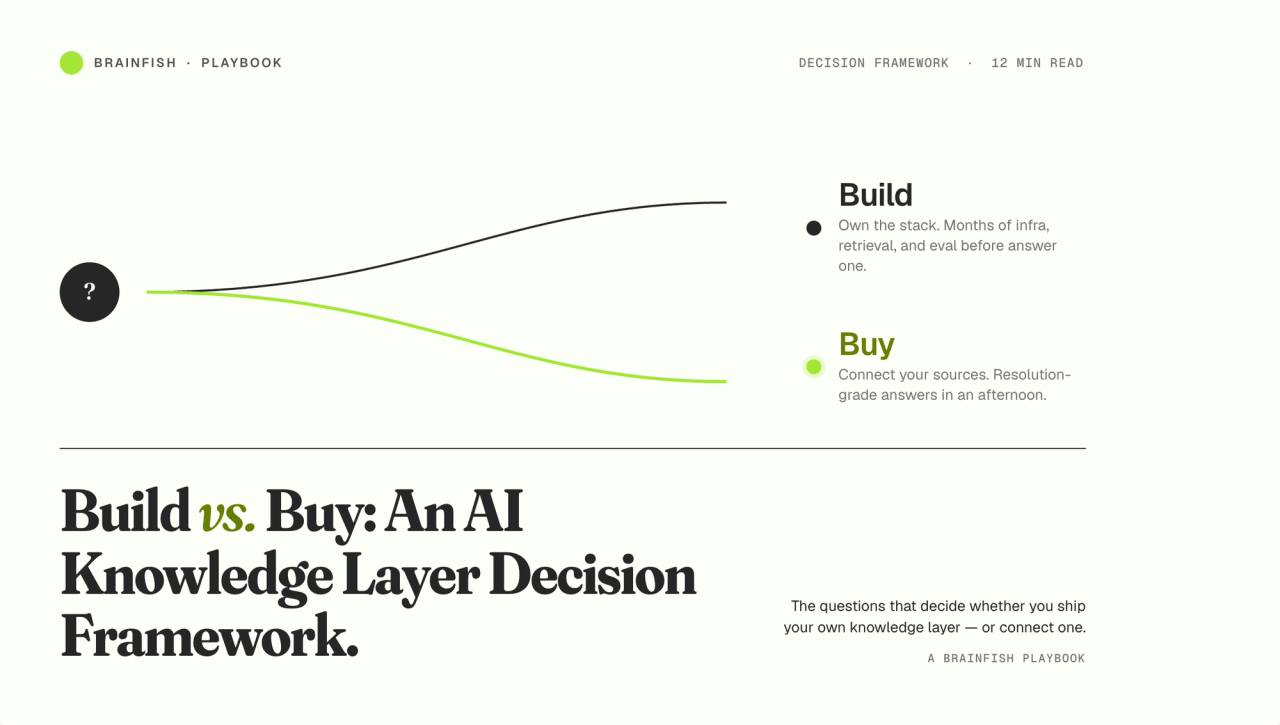
Build vs. Buy: An AI Knowledge Layer Decision Framework
Quick answer
For most teams in 2026, buying an AI knowledge layer is the right call. Building one looks cheap on paper — open-source RAG frameworks, a few embeddings, a vector store — until the six workstreams that don't show up in the original estimate appear in month four: content ingestion from every source, continuous content ops, retrieval observability, multi-surface serving, enterprise governance, and 24/7 operational tooling. Industry research attributes roughly 70% of AI support project failures to knowledge and infrastructure issues, not model quality, and those failures concentrate in internal build paths. Building still makes sense when your use case is narrow, single-surface, and your platform team has 18 months of capacity. It rarely does otherwise.
Every engineering leader who's ever said "we'll just build it" has, at some point, met the version of themselves six months later who is very tired and quietly rebudgeting. The AI knowledge layer is 2026's canonical example.
The build case is easy to write. Open-source RAG frameworks are mature. Vector stores are commoditized. The models themselves are APIs. A competent senior engineer can have a prototype shipping answers in two weeks. The first demo is great. The funding follows.
Then month three arrives, and the team discovers that the RAG pipeline was the easy part. Month six arrives, and the original estimate has doubled. Month nine arrives, and a vendor proposal that looked expensive now looks cheap. Month twelve arrives, and the team is either shipping a system they could have bought in week one, or shelving the project and standing up the vendor anyway.
This guide is the decision framework that prevents the month-twelve realization. It covers the real scope of building an AI knowledge layer, the places where building still makes sense, and the places where buying is obviously right. For the category pillar, start with What Is an AI Knowledge Layer? The Definitive Guide for 2026.
TL;DR
- Building an AI knowledge layer looks 3-6 months of eng work; actual projects run 12-24 months to production-grade.
- Six workstreams get under-scoped: ingestion, content ops, observability, multi-surface serving, governance, operational tooling.
- Total cost of ownership for a build usually exceeds a three-year vendor contract within 12 months.
- Buy if: multi-surface, multi-source content, under deadline, no platform team to spare.
- Build if: narrow single-surface use case, data-residency constraints that rule out vendors, platform team with real capacity.
- The 70% AI-failure attribution to knowledge issues concentrates in build paths that under-scope the surrounding system.
- AI coding agents (Claude Code, Codex) make the prototype nearly free but do nothing for the 80% that kills builds; cheaper prototyping deepens the false-confidence trap, it doesn't escape it.
Why the build case is so seductive
RAG is a pattern, not a product. Every open-source framework ships a working RAG pipeline in a day. The existence proof is free. That makes the implementation feel cheap.
The team already exists. Engineering teams that want to build usually have headcount assigned. The marginal cost of redirecting that headcount feels near-zero on a spreadsheet.
Vendor procurement is painful. Security review, legal review, privacy review, procurement process, vendor risk assessments — the buy path has overhead the build path appears to skip.
Buying feels like abdicating strategy. For engineering-led orgs, "we bought it" can feel less defensible than "we built it," especially when the CTO is asked what makes the AI investment differentiated.
Cost optimism. The first cost estimate almost always counts engineering hours for the RAG pipeline and nothing else. The estimate omits everything the RAG pipeline doesn't do, which is most of the work.
All of those are legitimate pressures. None of them survive contact with what actually happens in month four.
But doesn't Claude Code change the math?
This is the 2026 version of the build case, and it deserves a direct answer. AI coding agents (Claude Code, Codex, and the rest) have made the prototype nearly free. A senior engineer can now point an agent at the docs and have a RAG pipeline returning answers in an afternoon, not two weeks. The week-one demo is better than it has ever been.
That is real, and it changes nothing about the recommendation. Agentic coding compresses the 20% of the system that was always the easy part: the pipeline. It does almost nothing for the 80% that actually kills internal builds, the six workstreams below: multi-source ingestion that survives source-system upgrades, content ops that catches drift, retrieval observability, multi-surface serving, enterprise governance, and 24/7 operational tooling. An agent can scaffold a connector. It cannot own your content lifecycle, put your audit trail in front of a SOC 2 reviewer, or carry the pager at 2am when an ingestion silently breaks.
If anything, cheaper prototyping makes the trap worse, not better. A more impressive demo in week one produces more confidence, which means more teams sail past the buy decision and hit the same month-four wall, now with a codebase nobody fully understands because an agent wrote most of it. "Building has never been easier" and "building has never been more under-scoped" are both true at once. The pipeline got cheap. The system around it did not.
For the head-to-head on wiring ChatGPT or Claude to your docs versus buying the layer, see Brainfish vs Build-Your-Own (ChatGPT / Claude + your docs).
What a production AI knowledge layer actually has to do
The RAG pipeline is maybe 20% of the system. The other 80% is what separates a knowledge layer from a prototype.
1. Content ingestion from every source
Help center. Helpdesk KB. Product docs. Confluence. Notion. Past tickets. PDFs. Release notes. Each has its own schema, auth, access control, change rate, and failure mode. Building ingestion for six sources is a quarter of work, easily. Keeping those ingests running reliably through source-system upgrades is ongoing. See Help Doc Debt: 80% of Knowledge Bases Are Out of Date.
2. Content operations that catches drift
Knowledge drifts. Product ships weekly; docs ship quarterly. Release notes contradict help articles. Policies update without ripple effects across the content base. A working knowledge layer detects drift continuously — stale entries, conflicting sources, coverage gaps surfaced by unanswered questions — and routes each to a content owner.
Building this isn't obvious. It requires retrieval-time conflict detection, temporal tracking of content changes, owner-routing logic, and a queue that doesn't overwhelm content teams with false positives. Most internal builds skip it until accuracy degrades to the 70s and someone has to build it under pressure.
3. Retrieval observability
When the AI returns a wrong answer, support leads need to see which documents were retrieved, in what order, with what confidence, and why. Without this, every wrong answer is an eng ticket. With this, non-engineers participate in debugging.
Observability is harder to build than it looks. It requires logging every retrieval event at production volume, structuring the retrieval chain for human inspection, building the UI that makes it usable, and maintaining it alongside the RAG pipeline as both evolve.
4. Multi-surface serving
A RAG pipeline built for the chat widget answers in the chat widget. To also answer in the help center, in-product AI, the helpdesk, and internal AI, either you build five pipelines (five content syncs, five retrieval configurations, five observability surfaces) or you build a serving layer that abstracts the surface from the content source.
The serving layer is an architectural choice that has to be made early. Retrofitting it after shipping a single-surface pipeline usually requires a rebuild, not a refactor.
5. Enterprise governance, audit, access control
SOC 2. ISO 27001. GDPR. CCPA. Data residency. Retention. Deletion. Role-based access control on content. Audit trails on every retrieval. These aren't optional at mid-market and enterprise scale. Building them is typically a quarter of work each, executed by teams who aren't deep in compliance by default. Most internal builds under-invest here and discover the gap during procurement review of the vendor path they rejected six months earlier.
6. 24/7 operational tooling
Someone has to monitor the layer. Detect regressions. Roll back bad ingestions. Tune retrieval configurations. Run content audits. Handle incidents. The operational tooling — dashboards, alerts, runbooks, rollback procedures, reprocessing pipelines — is its own project. Most internal builds ship without it and spend the first six months of production inventing it reactively.
The honest cost model
The cost question splits into three buckets most build estimates collapse into one.
Add it up and a serious build runs $2M-$5M in year one for a mid-market org, $5M-$15M+ for enterprise. A three-year vendor contract rarely clears a fraction of that. The opportunity cost line is the one that moves CFOs. The engineers building ingestion aren't building product features. For 18 months.
For the detailed cost breakdown, see The Hidden cost of RAG Maintenance
The decision framework
Six questions. If you answer "yes" to four or more, buy. If you answer "yes" to zero or one, build might be defensible.
1. Do customers ask questions in more than one place?
Yes: buy. A single-surface build leaves the rest of the surfaces unanswered and doesn't compose without a rebuild.
2. Does knowledge live in more than one system?
Yes: buy. Multi-source ingestion is the under-scoped quarter of work that kills internal timelines.
3. Are you under a deadline measured in months, not years?
Yes: buy. Build paths run 12-24 months to production grade; buy paths run weeks to months.
4. Does your platform team have 18 months of uncommitted capacity?
No: buy. Platform teams never have uncommitted capacity. Building pulls them off roadmap work you'll regret later.
5. Are enterprise security, compliance, or audit requirements on your horizon?
Yes: buy. Buying a vendor with existing certifications is dramatically faster than building the controls in-house.
6. Is the knowledge layer your competitive differentiator?
No: buy. If the layer is a means to an end (supporting customers, enabling agents), buy it. If it's the actual product you sell, build might make sense.
Most teams honestly answering these land on four or more "yes" answers. That's the data. The emotional pull toward building is real; the framework is what gets the decision out of emotion and into architecture.
When building still makes sense
Three situations where internal build remains defensible in 2026:
1. Narrow, bounded, single-surface use cases.
One internal tool. One document set. One persona. Small blast radius. The surrounding infrastructure is genuinely smaller when scope is tight. A platform team can ship a working layer for a narrow use case in a quarter.
2. Data-residency or sovereignty constraints that rule out vendors.
Some regulated industries (certain government, defense, healthcare deployments) have hard constraints that vendor AI can't meet. If vendors are off the table by policy, building is the only path. Budget accordingly.
3. Platform teams with real capacity and existing content ops.
If the org already owns content pipelines, retrieval-evaluation harnesses, observability, and SRE capacity — and those capabilities aren't being pulled off other priorities — building on top of what exists is cheaper than it looks. This is rare. Most orgs that think they have this capacity discover in month three that they don't.
4. Knowledge-layer capability is a commercial product.
If you're building the knowledge layer to sell to customers (not to use internally), the investment model is different and building is the default. The rest of this framework applies to operational deployments.
What the build-path failure mode actually looks like
The internal-build failure mode isn't usually "it doesn't work." It's "it works at launch and degrades, and nobody has the bandwidth to fix it."
The sequence:
- Launch. Accuracy is high. Team is proud. Support leadership is happy. Executives celebrate.
- Month 2. Product ships three releases. Docs are behind. The layer starts citing stale content.
- Month 4. Support leaders ask why deflection is flat. Engineering investigates. Content drift is identified. No drift-detection tooling exists.
- Month 6. A new surface is requested (in-product AI). The current pipeline is surface-specific. Rebuild needed.
- Month 9. Security asks for SOC 2 audit trail. Audit logging wasn't in the original spec. Rebuild.
- Month 12. Engineering proposes either a major rebuild or standing up a vendor. Leadership has to choose between sunk cost and moving forward.
This sequence is so common that vendor RFCs regularly include "migrating from an internal RAG build" as a standard onboarding path. The year-one savings vanish in year two.
For the long-form of why this pattern recurs, read RAG is a Feature, Not a Product and Help Doc Debt: 80% of Knowledge Bases Are Out of Date.
Common misconceptions
"Buying locks us in."
Buying a layer that ingests content in place doesn't lock in content; the content stays in your systems. Migration off a vendor layer is usually less work than migration off an internal build with custom ingestion that nobody else understands.
"Our engineers can handle it."
Probably. The question isn't capability. It's capacity and opportunity cost. Capable engineers building a knowledge layer are capable engineers not building your product.
"Vendor pricing will escalate."
A three-year contract locks pricing. Internal build has no cap on scope creep or cost inflation. Vendor lock-in is frequently cheaper than scope lock-in on a homegrown system.
"We need full control."
Full control of the RAG pipeline doesn't translate to better outcomes. Control over content, content ops, and surface deployment is what matters. Vendors give you that control without the pipeline ownership.
"We'll start building and revisit if it's taking too long."
Teams that start building almost never migrate mid-project. Sunk cost keeps them going. The time to make this decision is before the first line of code.
The future: the gap widens
Two trajectories are making the build-vs-buy calculus more one-sided, not less.
Vendor knowledge layers are improving faster than internal builds can keep up. Multi-source ingestion, content ops, retrieval observability, multi-surface serving — these are where vendor R&D concentrates. Every quarter, the gap between a vendor layer and an internal RAG pipeline widens.
The cost of AI compute is falling, but the cost of operational surface area isn't. Models get cheaper. Embedding costs drop. Vector stores commoditize. None of that reduces the engineering time required to build the surrounding system. Opportunity cost, the biggest line, keeps rising as engineering talent gets more expensive.
The buy case strengthens every quarter. The build case gets narrower.
How to run the decision in your org
- Write the full scope document. Not just the RAG pipeline. All six workstreams above. Estimate honestly.
- Stage-gate the build estimate. If the estimate comes in under $2M year one for a mid-market deployment, the scope is probably incomplete.
- Run a vendor evaluation in parallel. Even if you plan to build, benchmark against 2-3 vendors. The evaluation surfaces scope gaps faster than any internal exercise.
- Talk to a vendor's production customer at month twelve. Launch-day metrics are always good. The month-twelve metrics separate vendors from each other and from internal builds.
- Make the decision before writing code. The sunk-cost trap is real. Revisiting build-vs-buy six months in usually doesn't happen.
For the broader pillar, What Is an AI Knowledge Layer? The Definitive Guide for 2026.
How Brainfish approaches the build-vs-buy conversation
Brainfish is the buy option for teams who've worked this framework honestly and landed on four-plus yeses. The design choices that follow:
- Ingests content in place. Your content stays in your systems. No migration. No lock-in on the content itself.
- Every surface served from one source. Help center, in-product, helpdesk AI, internal AI — no custom pipelines per surface.
- Content ops, observability, governance built in. The six workstreams that under-scope internal builds are the product.
- Live in days, not quarters. Teams who considered building for 18 months often ship the vendor path in 6 weeks.
Customers like Smokeball chose the vendor path and reached 83% self-serve deflection without the year-one build debt.