

AI Knowledge Base vs Traditional Knowledge Base: What's the Difference?
Quick answer: A traditional knowledge base is a human-authored, manually maintained collection of articles designed for human browsing. An AI knowledge base uses machine learning to automatically ingest, organise, and update knowledge from multiple sources — and is built for programmatic retrieval by AI agents and chatbots, not just human search.Every company has a knowledge base. Most of them are slowly breaking.
Not dramatically — no alarms go off when a help article goes three product releases out of date, or when the answer to a common question exists in a Gong recording that nobody can search. The knowledge base just quietly stops reflecting reality, while support tickets keep coming in and customers keep getting answers that used to be right.
The distinction between a traditional knowledge base and an AI knowledge base isn't primarily about technology. It's about whether knowledge can keep pace with a product that keeps changing.
This guide explains the practical difference between the two, when each is the right fit, and why more teams are making the transition.
What is a traditional knowledge base?
A traditional knowledge base is a structured collection of articles, guides, and FAQs that humans author, organise, and maintain. It's designed for human browsing: a user searches with keywords, finds a relevant article, reads it, and ideally finds the answer they were looking for.
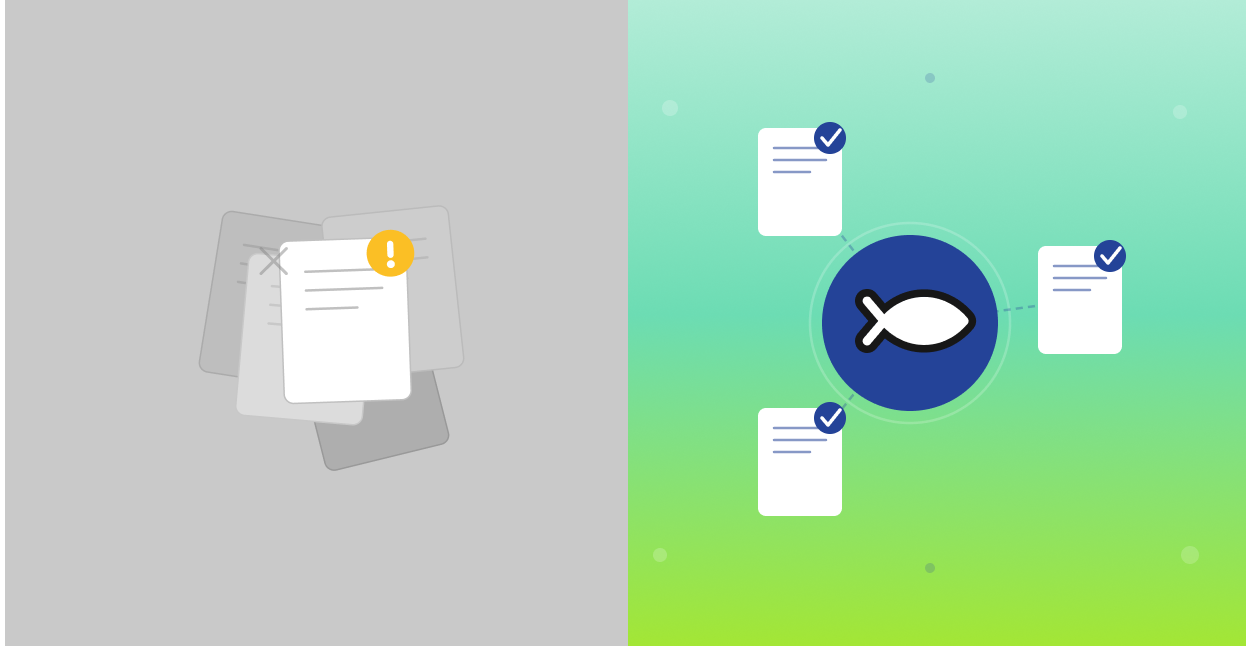
The defining characteristic of a traditional knowledge base is that it's human-maintained. Content is created when someone has time to write it. It's updated when someone notices it's wrong. The quality of the knowledge base reflects the capacity and attention of the team responsible for it — which means it tends to degrade over time unless someone is actively working to keep it current.
Traditional knowledge bases have been the standard for decades. Tools like Zendesk Guide, Intercom Articles, Confluence, and Notion all operate on this model. They're effective when the product is stable, the team has bandwidth to maintain content, and the volume of knowledge isn't growing faster than it can be managed manually. Research shows only 1 in 5 companies rate their knowledge base as "very accurate" — a direct consequence of manual maintenance at scale.
What is an AI knowledge base?
An AI knowledge base uses machine learning to automate significant parts of how knowledge is created, organised, and kept current. It ingests content from multiple sources — help articles, product documentation, call recordings, Slack threads, video walkthroughs — extracts structured knowledge from them, and maintains that knowledge automatically as sources change.
Critically, an AI knowledge base isn't just a traditional knowledge base with a better search bar. The architecture is different. Where a traditional knowledge base stores and surfaces full articles, an AI knowledge base works with semantic chunks — smaller units of meaning that can be retrieved, ranked, and assembled into answers dynamically. This is what makes it suitable as a backend for AI Agents and Chat bots, and why the same knowledge can power a customer-facing widget, an internal copilot, and a Slack bot simultaneously.
Related reading: What Is an AI Knowledge Base? The Complete Guide
The core differences
Content creation
In a traditional knowledge base, a human writes every article. This is the primary constraint on how quickly the knowledge base can grow and stay current. If no one has time to write, nothing gets written.
An AI knowledge base can generate structured content from existing sources: upload a product demo video and get a set of help articles. Connect a Gong recording library and extract the answers your best reps give to common questions. Run a new feature announcement through the system and get automatically updated articles flagging what changed. The writing still happens — but increasingly, humans review and approve rather than draft from scratch. Teams using this approach have eliminated hundreds of hours of annual documentation overhead that would otherwise fall on their content or support teams.
Keeping content current
This is where the gap is most visible. A traditional knowledge base requires a human to notice when content is wrong and manually update it. In practice, this means knowledge degrades between updates — especially in fast-moving products.
An AI knowledge base monitors source content for changes. When the product ships a new feature, when a pricing page is updated, when a configuration option is removed — the system detects the change, identifies which knowledge is affected, and either regenerates the relevant articles or flags them for review. The maintenance loop is automated, not manual.
Search and retrieval
Traditional knowledge base search is keyword-based. A user types "how do I reset my password" and gets articles that contain those words. If the article uses different terminology, it may not surface. Synonyms, paraphrases, and intent variations are all weak points.
AI knowledge base retrieval is semantic. A user asking "I can't get back into my account" and a user asking "how do I reset my password" are asking the same question and get the same answer, because retrieval is based on meaning rather than keyword matching. This is a meaningful improvement in self-service resolution rates — users find what they need even when they don't know the right search terms.
Machine-readability
Traditional knowledge base articles are formatted for human readers: paragraphs, headers, bullet lists. This format is poorly suited to programmatic retrieval by AI agents, which need semantically coherent chunks with structured metadata.
AI knowledge bases are designed for both human readers and machine retrieval. The same knowledge powers a human-facing help centre and an AI agent's retrieval layer, without requiring separate authoring for each.
Personalization
A traditional knowledge base typically serves the same content to every user regardless of their account, plan, or configuration. A user on a basic plan and an enterprise customer with custom integrations both see the same help articles.
An AI knowledge base can segment knowledge by account context, user role, plan tier, or product configuration. The customer on a complex enterprise plan gets answers relevant to their setup. The new user gets simplified onboarding content. This isn't just a better experience — it reduces wrong-path support tickets that happen when customers follow instructions designed for a different configuration.
Side-by-side comparison
Criteria Traditional Knowledge Base AI Knowledge Base Content creation Human-authored Auto-generated from source content, human-reviewed Staying current Manual updates Automated freshness detection and regeneration Search Keyword-based Semantic and intent-based Machine retrieval Poor (designed for humans) Built for both humans and AI agents Personalisation One-size-fits-all Segmented by account, role, plan Scales with product growth Requires more writers Scales automatically Best for Stable products, dedicated content teams Fast-moving products, AI-powered support workflows
When a traditional knowledge base is still the right choice
Not every team needs an AI knowledge base. A traditional knowledge base is the right fit when:
- Your product is stable. If the product doesn't change frequently, manual update cycles are manageable and the overhead of an AI knowledge base may not be justified.
- Your content volume is small. A knowledge base of 50 articles can be maintained manually by a single person. The automation benefits of an AI knowledge base are most felt at scale.
- You don't need to power AI agents. If your support workflow is human-led and you're not deploying chatbots or agent assist tools, the machine-readability benefits of an AI knowledge base are less relevant.
- You have a dedicated content team. Organisations with full-time technical writers or content specialists can maintain a high-quality traditional knowledge base. The constraint is usually bandwidth, not the technology.
When you need an AI knowledge base
An AI knowledge base becomes the right architecture when:
Your product ships frequently. Weekly releases mean weekly opportunities for knowledge to go stale. Manual update cycles simply can't keep pace. Automated freshness detection closes the gap.
Your knowledge is spread across systems. If the answer to a common question lives in a call recording, a Slack thread, and an outdated Confluence page, you need something that can ingest all three, deduplicate the knowledge, and surface the most accurate version. No traditional knowledge base can do that.
You're deploying AI-powered support. Chatbots and agent assist tools are only as good as the knowledge they retrieve. If you're putting AI in front of customers, you need the knowledge layer underneath it to be accurate, current, and machine-readable.
You're scaling faster than your content team can. If the support ticket volume is growing and the knowledge base is falling behind, the solution isn't more writers — it's automated knowledge creation and maintenance.
You're losing deals or seeing churn that traces back to knowledge gaps. If customers can't find the right answer, they open tickets, get frustrated, or churn. At scale, this is measurable — and addressable.
The migration question
For teams moving from a traditional to an AI knowledge base, the practical question is what to migrate and what to leave behind.
The honest answer is that most traditional knowledge bases are not worth migrating in full. A significant portion of articles in a typical help centre are out of date, redundant, or answering questions nobody asks. An AI knowledge base is a good opportunity to start from the sources of truth — product documentation, recent call recordings, well-maintained internal wikis — rather than porting stale content.
The articles worth migrating are the ones with strong traffic, high engagement, and recent review dates. Everything else is better regenerated from primary sources than imported as-is.
Key takeaways
- Traditional knowledge bases are human-authored and human-maintained — they work well for stable products with dedicated content teams, but degrade quickly in fast-moving environments
- AI knowledge bases automate content creation, freshness detection, and semantic retrieval — they're built to keep pace with a product that ships weekly and to power AI-driven support workflows
- The most significant difference in practice isn't search quality or personalization — it's whether the knowledge can stay current automatically, without requiring someone to notice it's wrong
- If you're deploying AI agents or chatbots, the knowledge base underneath them determines whether they resolve issues or erode trust
Explore the full definition: What Is an AI Knowledge Base? The Complete Guide. Learn how Brainfish's AI Knowledge Layer powers knowledge operations for fast-moving product teams.