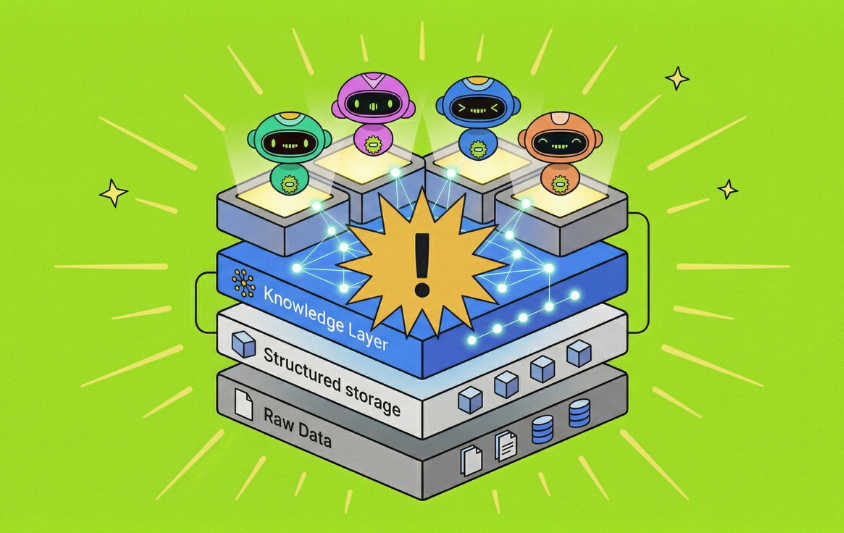
TL;DR: Knowledge infrastructure is the foundation that determines whether your AI agents are consistent, current, and correct. Without a unified knowledge layer, you'll face cross-agent contradictions, knowledge drift, and maintenance overhead that compounds with every new agent you ship. The teams that get this right build it early or buy it before they hit the consistency crisis.
The Reality of Agent Knowledge
You're building AI agents. Everything works great with one agent. Two weeks later, you have three. By month two, your support agent is answering questions differently than your onboarding agent. Your product shipped a feature update, and some agents know about it but others don't.
This is not a model problem. This is a knowledge infrastructure problem.
The unsexy truth: your AI agent's quality ceiling is set by the quality, consistency, and currentness of the knowledge it has access to. You can have a brilliant model trained on everything, but if it's querying fragmented, stale, contradictory knowledge about your product, it will give wrong answers. Every time.
This is where most teams get it wrong. They optimize for the model. They debate between GPT-4 and Claude and Llama. They build perfect prompt chains and multi-step reasoning. Then they bolt on knowledge as an afterthought - a vector database, maybe a RAG pipeline, maybe just context windows stuffed with docs. And it works. Until it doesn't.
Knowledge infrastructure is the unsexy work that makes or breaks AI agents at scale.
Why Knowledge Infrastructure Is the Foundation, Not an Afterthought
Let's be direct: your agent is only as good as the knowledge it can access.
If an agent is asked "What's our billing refund policy?" and the knowledge source says "refunds are 30 days" but you updated that policy to 45 days last week and never updated the knowledge base, the agent will confidently tell a customer something wrong. The model didn't fail. Your reasoning chain didn't fail. Your knowledge infrastructure failed.
Now scale that up. You have a support agent, an onboarding agent, a sales assistant, and a technical documentation agent. Each one is querying the same product knowledge, but they're pulling from slightly different sources, one is using last month's docs, another is using an out-of-date Confluence page. They give different answers to the same question. Your customer support team sees the inconsistency and loses trust in all the agents.
This happens every day in production systems. And it's preventable, but only if you think about knowledge infrastructure as a first-class system component, not a database query to bolt on later.
The Two-Tier Architecture Most Teams Start With (And Why It Breaks)
Most teams land on a two-tier knowledge architecture, almost by accident:
This works fine when you have one agent. You update your docs in Confluence, you run an embedding job once a week, and the agent picks up the changes. There's latency, but it's manageable.
Now you have three agents. They're asking the same questions of your knowledge base, but getting different answers. Why? Because they're pulling from different snapshots. Agent A pulled the embeddings from Tuesday, Agent B pulled them from Friday. Or they're using different retrieval strategies. Or the vector index isn't updated yet. Or they're querying different source systems entirely.
The hot/cold memory model assumes:
None of these assumptions hold at real agent scale.
At three agents, the maintenance overhead starts to hurt. At five agents, it's breaking. At ten agents across multiple product teams, you have a knowledge crisis: nobody knows which source is authoritative, updates get lost, agents give different answers to the same question.
6 Agentic Knowledge Patterns in Production
Production systems that scale consistently adopt these patterns. They're not theoretical. They're what you see in systems that work.
Pattern 1: Source-of-Truth Anchoring
All agents in the system query the same authoritative knowledge layer. Not different knowledge sources. Not agent-specific data stores. One source of truth.
This sounds obvious, but it's not how most teams start. They think: "Agent A is a support agent, it needs support docs. Agent B is a sales agent, it needs sales materials." So they give each agent its own knowledge base. That's when everything breaks. When product changes, you're updating multiple sources. Docs and sales materials diverge. Agents give different answers.
Source-of-truth anchoring means: when a product fact changes; pricing, feature availability, refund policy- it changes in one place. All agents see it immediately.
Pattern 2: Automatic Knowledge Propagation
Product change → knowledge layer updates automatically →all agents draw from current knowledge.
This is the difference between knowledge infrastructure that scales and knowledge infrastructure that becomes a bottleneck. Manual knowledge update cycles- "someone needs to update the docs after every release" don't scale. You'll miss updates. You'll have stale knowledge. Agents will give wrong answers.
Real systems have automatic propagation: a product doc changes in Confluence, the knowledge layer detects it, agents accessing that knowledge immediately get the update.
Pattern 3: Conflict-First Architecture
Knowledge contradictions are detected at the knowledge layer, not surfaced as agent errors later.
If two documents say contradictory things about the same feature, most systems let both into the knowledge layer and hope retrieval picks the right one. When agents query that knowledge, they get contradictory information. They either hallucinate a resolution or give a wrong answer.
Conflict-first architecture means: contradictions in the knowledge layer are identified, surfaced, and resolved before an agent ever queries that knowledge.
Pattern 4: Hierarchical Context Retrieval
Agents get document-structure-aware answers, not flat chunks.
Most retrieval systems are chunk-based: you ask a question, the system returns the most similar 500-word chunk. If the answer requires understanding document structure, how a section relates to subsections, what context preceded it - you lose that.
Real agentic systems understand document hierarchy. A question about "how do we handle refunds?" returns not just "refunds are 45 days" but the complete refund policy section with its sub-policies, exceptions, and related context.
This is the difference between standard RAG (55%- 70% accuracy on complex document benchmarks) and Hierarchical Retrieval Reasoning - 100% pass rate on the same benchmarks.
Pattern 5: Full Retrieval Tracing
Every agent answer can be traced back to the exact knowledge node retrieved.
An agent gives an answer. A customer disputes it or a team member questions it. You need to know: what knowledge did the agent retrieve? From which source? When was that source last updated? Which other agents queried the same knowledge?
Without full tracing, you're debugging blind. With tracing: "Agent A retrieved outdated docs from this Confluence page, updated 6 days ago, which has since been corrected. Agent B retrieved the current version."
Pattern 6: MCP Gateway Pattern
Agents access knowledge through a standardized protocol, not direct source connections.
Most teams let each agent connect directly to its knowledge sources. Agent A hits Confluence. Agent B hits Notion. Agent C reads from Google Drive. This creates brittle systems: if Confluence goes down, Agent A breaks. If an API rate limit is hit, everything degrades. If you need to add a new knowledge source, you update every agent's code.
The MCP (Model Context Protocol) gateway pattern centralizes this: agents don't query knowledge sources directly. They query a knowledge gateway that abstracts the underlying sources. You add a new knowledge source? You update the gateway. One change, and all agents are protected.
The Cross-Agent Consistency Problem
Here's a scenario that happens in production:
Your company ships a feature change. The product docs are updated in Confluence on Tuesday. Your support agent's knowledge index was last updated Sunday. Your onboarding agent's was updated Wednesday.
A customer asks both agents about the feature.
Support agent: "That feature works like X." (based on old docs)
Onboarding agent: "That feature works like Y." (based on new docs)
Customer is confused. Your team is confused. Which agent is right?
This is a knowledge infrastructure failure, not a model failure. The two agents are querying knowledge at different points in time. There's no way to prevent this without unified, synchronized knowledge infrastructure.
Cross-agent consistency can't be solved at the model level or the prompt level. It has to be solved at the knowledge level: all agents querying from the same, synchronized source of truth.
How Auto-Updating Knowledge Propagation Works
The mechanics are straightforward. The impact is enormous.
What this eliminates: manual knowledge update cycles, knowledge drift, surprise inconsistencies.
Without this, every update to product knowledge requires manual coordination across every agent that uses it. With auto-propagation, the pipeline is transparent and automatic.
Build vs. Buy: The Decision Framework
You need knowledge infrastructure. The only question is whether you build it or buy it.
Build vs. Buy: Decision Framework:
How many agents?
- Build: 1–2
- Buy: 3+
How often does product knowledge change?
- Build: Monthly or less
- Buy: Weekly or more
Do you need cross-agent consistency?
- Build: No
- Buy: Yes
What’s the cost of an agent giving wrong info?
- Build: Low
- Buy: Medium to High
How many people do you want maintaining knowledge infrastructure?
- Build: 1 FTE
- Buy: 0 additional headcount
If your answers are "multiple agents, frequently changing knowledge, cross-agent consistency required, high cost of error" → buy.
The build cost reality:
- 3 months to build connectors to Confluence, Notion, Drive, Slack
- 1+ sprint per month ongoing maintenance
- $500–600k over three years in engineering cost and opportunity cost
- They still break when APIs chan
The knowledge layer is where agent quality is won or lost. Talk to an architect about your knowledge infrastructure
Knowledge infrastructure is the foundation that determines whether your AI agents are consistent, current, and correct. Without a unified knowledge layer, you'll face cross-agent contradictions, knowledge drift, and maintenance overhead that compounds with every new agent you ship.