
TL;DR
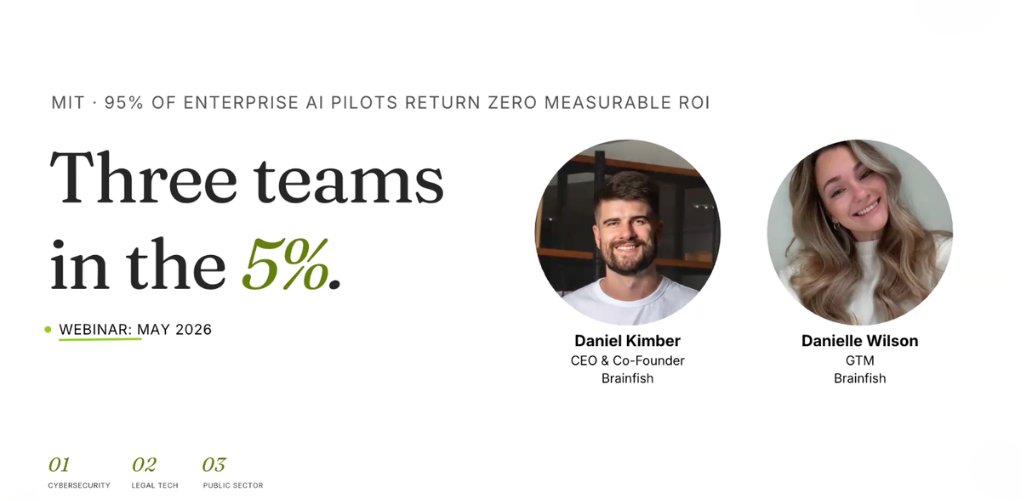
MIT research found that 95% of enterprise AI pilots return zero measurable ROI. The 5% that succeed share one trait: they build a continuous knowledge layer that gives the AI context about both the product and the customer, instead of bolting a generic AI agent onto a stale knowledge base.
This post breaks down three Brainfish customers in that 5%:
- A cyber SaaS company automating 80% of inbound support tickets while pausing a planned 50% headcount expansion.
- A legal tech platform automating 74% of tickets across 256+ product/pricing combinations and lifting NPS by 37 points.
- A US city government moving from handwritten SOPs to instant multilingual answers in Microsoft Teams for 600 staff.
The pattern is the same in every case. Read on for what they actually built.
🎥 Prefer to watch? Stream the full 45-minute webinar replay →
Why 95% of AI Pilots Fail
In 2025, MIT's NANDA initiative published findings that have since been quoted in nearly every enterprise AI conversation: roughly 95% of generative AI pilots in enterprises return no measurable financial ROI. Most never make it past the proof-of-concept stage.
The reflex is to blame the model. Or the vendor. Or the budget.
It's almost never any of those.
After working inside the knowledge infrastructure of hundreds of AI deployments, the pattern at Brainfish is consistent: AI pilots fail because the AI doesn't have the right context. Not the right model. Not the right prompt. The right context.
A generic AI agent connected to a generalist knowledge base will produce generalist answers. Good enough for a demo. Useless to a real customer with a real product on a real plan in a real region.
The 5% that succeed do something specific:
- They consolidate scattered knowledge — Zendesk articles, Slack threads, call recordings, internal docs, app session recordings — into a single source of truth.
- They segment that knowledge by product, plan, region, and customer cohort.
- They distribute it through the channels their customers already use, instead of forcing migrations.
- They measure deflection AND experience, not just deflection.
Below are three customers doing exactly that.
Case Study 1: Cyber SaaS: 80% Ticket Deflection in a Zero-Tolerance Audience
The before state
A cybersecurity SaaS company serving MSPs and IT partners came to Brainfish with about 5,000 hyper-technical tickets per month. Their audience does not tolerate vague or wrong answers — incorrect guidance during a security incident isn't a customer service problem, it's a risk event.
Their knowledge was scattered across Zendesk articles, Slack threads, and tribal memory in the heads of senior support engineers. They had already tried Zendesk AI and Intercom Fin and couldn't hit the accuracy required for the audience. They were experimenting with pulling Zendesk exports into Claude to manually theme tickets.
The forcing function: they were growing 50% year-over-year and on track to scale support headcount by the same 50% — which the team didn't want to do.
What they built
Brainfish was added as a knowledge layer on top of Zendesk and Slack. Nothing was ripped out.
- Zendesk stayed as the ticketing system. Brainfish replies to incoming chats and emails inside Zendesk with answers built from a unified knowledge base.
- Slack became the escalation surface. When an issue can't be solved by AI, Brainfish routes it to the right Slack channel with full context — not a raw ticket dump.
- Compliance guardrails were built in to prevent the AI from returning PII or providing guidance on regulated cybersecurity scenarios where a wrong answer is dangerous.
The results
- 80% of inbound chats automated.
- 2–3 second average response time. Critical in cybersecurity, where speed of response during an active incident matters.
- 24/7 coverage across US, EU, and APAC time zones without expanding headcount.
- Headcount plan paused. The 50% support team expansion is no longer needed.
Why it worked
The team didn't replace their stack. They gave their existing stack the context it had been missing.
Case Study 2: Legal Tech — Personalization Across 256+ Product Combinations
The before state
A legal tech platform serves lawyers across multiple practice areas with 4 products, each with 3–4 pricing tiers, producing 200+ combinations of plan, packaging, and product. One generalist knowledge base was answering every customer the same way — which meant most answers were technically correct and practically useless.
Compounding the problem: law in the US differs by state, law in Australia differs from US law, and APAC has its own regulatory shape. A generic answer about a feature can be wrong for a customer in a different jurisdiction.
What they built
Brainfish helped them split one knowledge base into roughly 12 segmented knowledge sets — without losing a single source of truth.
The architecture:
- Source ingestion. Existing Zendesk content, community articles, learning center material, internal Slack, call recordings, tickets, and app session recordings all flow into Brainfish's knowledge intelligence layer.
- Source-of-truth generation. When sources contradict each other, app session recordings are used as ground truth — they show what the product actually does today, not what someone wrote about it 18 months ago.
- Segmentation. The single source of truth is split into specialist knowledge bases per product, per plan, per region, and per cohort.
- Distribution. Answers are delivered through an in-app AI agent, the help center, an email-reply agent in Zendesk, and a customer success agent in Slack.
Personalization runs without PII. Brainfish only needs to know what plan, product, and region the user is on — not who they are.
The results
- 74% of inbound tickets automated (up from a more generalist solution that started in the 30–40% range).
- 37-point NPS lift over 12 months. NPS was the harder number to move — it's the proof that customers are getting better experiences, not just fewer responses.
- 98% answer accuracy, validated by audits with the customer's own support team.
- Support team repurposed. Freed-up capacity now runs customer marketing, churn-risk renewals, and field marketing pop-ups in front of customer offices.
Why it worked
Personalization without PII. Specialist knowledge per cohort. Source-of-truth knowledge that updates as the product changes — not a static help center that ages.
Case Study 3: US City Government — From Paper SOPs to Multilingual Instant Answers
The before state
A US city government with about 600 staff was writing standard operating procedures by hand, on paper. Some of those procedures predated the internet. Knowledge was technically accessible — but only through HR. The rest of the workforce had no searchable system.
The workforce is multilingual. Many staff speak Spanish or Haitian Creole as a first language. English-only SOPs created an obvious accessibility gap.
What they built
Two pieces did most of the heavy lifting:
- Video-to-SOP ingestion. Department leads — IT, procurement, HR, parks, public works — recorded themselves performing each procedure. Brainfish converted those recordings into structured SOP documents automatically. What used to take days of writing took minutes of recording.
- Multilingual AI chat. The chat experience was deployed in English, Spanish, and Haitian Creole, then surfaced inside Microsoft Teams so staff could ask questions where they already work.
The results
- From 0 to ~300 staff with self-serve access to the knowledge base (up from HR-only).
- Native-language answers for Spanish and Creole speakers, including frontline workers in parks, public works, and citizen services.
- Instant onboarding for new hires across every department, with up-to-date SOPs that mirror current process.
- Days of writing collapsed to minutes of recording.
Why it worked
The team met workers where they already were (Microsoft Teams, native language) instead of asking them to learn a new system. The knowledge layer absorbed institutional memory — including the parts that lived in nobody's documentation.
What All Three Have in Common
Three completely different industries. Three completely different stacks. One shared playbook.
Pattern Cyber SaaS Legal Tech City Government Did not rip and replace ✓ Kept Zendesk and Slack ✓ Kept the help center and Zendesk ✓ Layered onto Microsoft Teams Unified scattered knowledge ✓ Tickets, Slack, and tribal knowledge ✓ Docs, community content, and recordings ✓ Paper SOPs, LMS content, and video Personalized by context ✓ By customer type ✓ By product, plan, and region ✓ By language and department Measured beyond deflection ✓ Speed and coverage ✓ NPS and accuracy ✓ Access and onboarding speed Repurposed the team ✓ Paused hiring ✓ Shifted focus to field marketing and retention ✓ Expanded into department-wide SOP authoring
The common thread is context — context about the product (what it does, in this region, on this plan, in this version), and context about the customer (who they are, what they're trying to do, what tier they're on).
That's the entire delta between the 5% and the 95%.
How to Tell If Your AI Pilot Is in the 95% (or the 5%)
Five diagnostic questions:
- Where does your knowledge live today? If the answer is "across Zendesk, Notion, Slack, Drive, and a few people's heads" — and your AI only reads one of them — you are missing context.
- Does your AI know what plan the customer is on? If every customer gets the same answer regardless of tier, region, or product, your AI is generalist. Generalist answers don't drive ROI.
- What happens to the 20–30% the AI can't solve? If it dumps a raw transcript on a human agent, you're saving deflection cost but adding handoff cost. Escalations need context too.
- Are you measuring NPS or just deflection? Deflection alone doesn't prove the AI is helping the customer. NPS, CSAT, and resolution time prove the experience improved.
- What is your support team doing with the time you saved? The 5% turn freed-up capacity into customer marketing, churn rescue, and retention. The 95% just shrink the team.
If three or more of these answers feel uncomfortable, your pilot is likely in the 95%.
What to Do Next
Three concrete moves, in order of effort:
- Audit your knowledge. Pull every source the AI can reach today — help center, internal docs, tickets, call recordings — and check whether each is up to date, segmented, and contradicting nothing else. If you have an MCP-capable AI like Claude, you can do this in days, not months using the Brainfish MCP.
- Map context to cohort. List the plans, products, regions, and personas you serve. Map which knowledge is universal and which is specific. The specifics are what most pilots miss.
- Don't migrate. Layer. Keep your ticketing, your chat, your help center. Add a knowledge layer underneath that feeds all of them with the right context per customer.
See It in Your Own Stack
Brainfish is offering free context audits for AI implementations. No sales pitch — just a structured review of your knowledge, segmentation, and integration setup, benchmarked against the patterns above.
Related Reading
- Watch the full webinar: What AI Support Actually Looks Like When It Works →
- AI Knowledge Base: The Ultimate Guide for 2026 →
- AI Knowledge Base vs. Chatbot: Which Does Your Support Team Actually Need? →
- What We Learned from Analyzing 1M Support Interactions →
- The $90 Billion Race to Supercharge Customer Service with AI →
- How Brainfish works: the knowledge layer for AI →
- Brainfish customer stories →