Notes from the front of AI customer support.
Practical writing on building, deploying, and scaling AI agents that talk to real customers, from the team that ships them. No takes on AGI. Plenty on grounding, citations, and the cost of being wrong.
Latest writing.
Fresh takes, build notes, and customer stories.
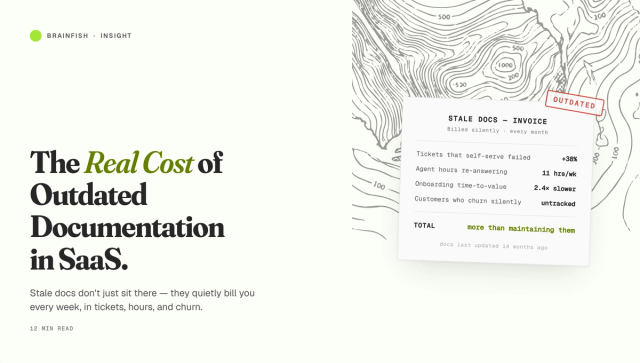 Posts The Real Cost of Outdated Documentation in SaaS Outdated documentation isn't just an inconvenience. It's a compounding cost center. Here's how to quantify what stale content is actually costing your SaaS business, and what to do about it. D Daniel Kimber Read article
  Posts Introducing Brainfish for Microsoft Teams Brainfish for Microsoft Teams is live. @mention the bot in any channel, get a sourced answer in seconds. The Slack pattern, now native to Teams. D Daniel Kimber Read article
 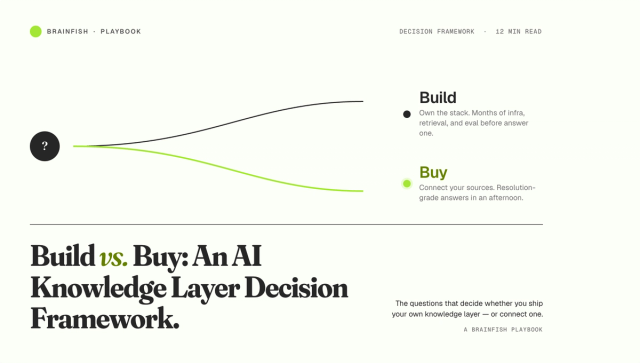 Posts Build vs. Buy: An AI Knowledge Layer Decision Framework Should you build your own AI knowledge layer or buy one? A 2026 decision framework covering cost, time, risk, and the work most build estimates miss. D Daniel Kimber Read article
  Posts MCP for Customer Support: The Ultimate 2026 Guide What MCP means for CX, what to do with it in your first 30 days, and how to make Claude an operator on your knowledge not just a chatbot. From the team at Brainfish. D Daniel Kimber Read article
  Posts AI Customer Support: The 2026 Guide for B2B SaaS Teams D Daniel Kimber Read article
  Posts Introducing Brainfish Live Agent Handoff for Zendesk Brainfish Live Agent Handoff for Zendesk transfers the full AI conversation to a human agent in the same window. No re-explaining. No starting blind. D Daniel Kimber Read article
  Posts The Complete Guide to Brainfish + Zendesk 2026 The 2026 guide to running Brainfish alongside Zendesk. Architecture, integration points, Live Agent Handoff, agent assist, content ops, customer proof. D Daniel Kimber Read article
  Posts The Dead-End Handoff: Why Most AI Support Tools Still Drop the Customer Most AI support tools dead-end the customer when they cannot resolve. The handoff is the most damaged moment in the conversation. It does not have to be. D Daniel Kimber Read article Posts The 5 Components of a Real AI Knowledge Layer A real AI knowledge layer is five components, not a chatbot. Sources, ingestion, content operations, observable retrieval, and multi-surface serving. D Daniel Kimber Read article Posts The AI Knowledge Layer Buyer's Guide for Heads of Support An AI knowledge layer buyer's guide written for the CX leader. Eight evaluation criteria, the traps to avoid, and how to score vendors against deflection and CSAT. D Daniel Kimber Read article
 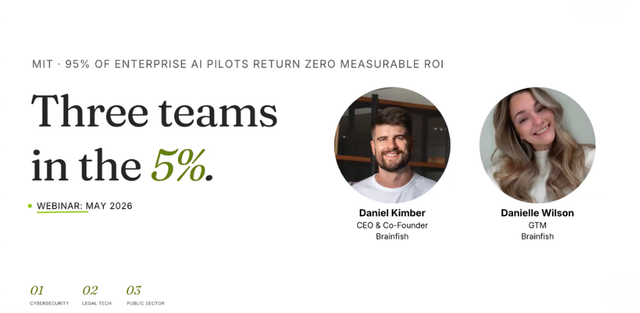 Inside the 5%: How Three Companies Made Their AI Pilots Actually Deliver ROI Why do 95% of AI pilots fail to show ROI? Three case studies show the 5% that win: unified knowledge, context by cohort, and measurable support automation. D Daniel Kimber Read article
  Posts April Launch Round-Up: Brainfish Works Where Your Team Works B Brainfish team Read article
  Posts 7 things support, CS, and product teams are doing with Brainfish MCP and Claude D Daniel Kimber Read article
  Posts AI Knowledge Base for Customer Support Learn what an AI knowledge base for customer support is, why traditional help centres fail at scale, and how to implement a self-updating knowledge layer that improves resolution rates across every channel. J Justin Gabriel Read article
  Posts How to Build an AI Knowledge Base Most teams build an AI knowledge base backwards. They connect an existing help centre to an AI tool, watch the demo perform well, ship it, and then watch it quietly fail over the following months as the product evolves and the knowledge doesn't. Tickets rise. Confidence scores drop. The team blames the AI model. The model isn't the problem. The knowledge infrastructure is. Building an AI knowledge base that actually works in production, not just in demos, requires a different approach than building a traditional help centre. This guide walks through each step. J Justin Gabriel Read article
  Posts Why Your AI Support Is Only as Good as Your Knowledge Layer Most AI support deployments fail for knowledge reasons, not model reasons. This post lays out why AI support quality is a function of the knowledge layer behind it, what a working knowledge layer looks like, a concrete diagnostic to run on your own AI, and the 2026 moves support leaders are making as a result. J Justin Gabriel Read article
  Posts What Is an AI Agent Knowledge Base? What Is an AI Agent Knowledge Base? Quick answer: An AI agent knowledge base is a structured, machine-readable repository that an AI agent queries in real time to answer questions and execute tasks. It differs from a traditional knowledge base in that it is designed for programmatic retrieval rather than human browsing, and must stay automatically current as the underlying product changes.AI agents are only as good as the knowledge they can access. Build a flawed knowledge base and your AI agent hallucinates, misroutes, or confidently answers the wrong question. Build a strong one, and your agent resolves issues end-to-end without human intervention. D Daniel Kimber Read article
  Posts AI Knowledge Base vs Traditional Knowledge Base Traditional knowledge bases are human-written and quickly go stale as products change. AI knowledge bases ingest information from multiple sources, keep answers fresh, and power semantic retrieval for AI agents and chatbots. This guide breaks down the differences, when each approach fits, and what to consider if you’re migrating. J Justin Gabriel Read article
  Posts Retrieval Observability: Seeing the Full Chain Behind Every AI Answer TL;DR: Retrieval observability means seeing the entire chain of how an AI system retrieved and ranked information before generating an answer not just the final output. Without it, debugging a wrong AI answer is like debugging a SQL query by only looking at the UI result. The solution: trace every retrieval decision, make answers deterministically reproducible, and expose confidence scores so you're asking the right question, what did the model retrieve? not just what did it say? D Daniel Kimber Read article The Hidden Cost of RAG Maintenance: When Knowledge Pipeline Work Consumes Your Sprint TL;DR: Most teams building RAG systems spend 20–30% of sprint capacity on knowledge pipeline maintenance (connector updates, doc syncing, accuracy regression testing) instead of building their actual product. For a senior engineer at $200–250k/yr fully loaded, that's $40–75k annually in pure maintenance overhead before you count the accuracy failures downstream. Auto-updating knowledge layers eliminate this tax entirely, freeing your team to focus on what they should be building. D Daniel Kimber Read article
  Posts How to Automate Support Deflection Using AI Inside Your Product Learn how to deflect support tickets with in-product AI , from auditing and structuring your knowledge base to choosing the right in-app touch points, setting smart escalation paths, and measuring what actually moves deflection rate. J Justin Gabriel Read article
  Posts AI Knowledge Base: The Ultimate Guide for 2026 Brainfish’s 2026 guide explains what an AI knowledge base is, how it differs from a traditional knowledge base, and how to build one that reduces hallucinations and improves self‑serve support. An AI knowledge base is the knowledge layer under chatbots and agents: it ingests information from help centers, tickets, Slack, and release notes; structures it into AI‑ready semantic chunks with metadata and embeddings; and serves grounded answers via retrieval‑augmented generation (RAG) with feedback loops and analytics. D Daniel Kimber Read article
  Posts Why 'We Need More Training' Is Killing Your Sales Performance, and How AI Enablement Fixes the Real Problem *The modern enablement engine isn't about producing more content. It's about delivering trusted knowledge at the exact moment it matters.* Sales leaders say it constantly: *"We need more training."* It's the go-to response when pipeline misses, demos bomb, reps struggle with basic objections. It feels controllable. You can schedule it, measure it, point to it in a QBR. D Daniel Kimber Read article
  Posts Cut Support Back-and-Forth in Half: Brainfish Now Supports Image Attachments J Justin Gabriel Read article
  Posts Knowledge Infrastructure for AI Agents: Why the Knowledge Layer Is the Most Important Part of Your Stack D Daniel Kimber Read article The Knowledge Layer API: How to Point Your RAG Pipeline at Clean, Current Knowledge TL;DR: Your RAG pipeline's accuracy problem isn't retrieval. It's knowledge quality. A knowledge layer API sits between your retriever and source documents, auto-syncing fragmented sources (Confluence, Notion, Slack, Drive), detecting conflicts before they reach the model, and eliminating the custom connector maintenance that kills most teams. Point your LangChain retriever at a clean endpoint instead of managing five broken pipelines. D Daniel Kimber Read article
  Posts RAG Accuracy Degradation in Production: Why It Happens and How to Stop It RAG accuracy degradation in production stems from knowledge staleness, fragmentation, and retriever blindness, not your model. Learn root causes and fixes. D Daniel Kimber Read article
  Posts Reduce Slack Escalations to Engineering Reduce Slack escalations without slowing your team. Learn how to give support better context, build structured workflows, and keep documentation up to date so engineers stay focused and product velocity stays high. J Justin Gabriel Read article Posts AI Knowledge Base vs. Chatbot: Which Does Your Support Team Actually Need? J Justin Gabriel Read article
  Posts What Is an AI Knowledge Base? The Complete Guide An AI knowledge base uses machine learning to automatically organize, surface, and update your support content. Here's what it is, how it works, and why static help centers are no longer enough. D Daniel Kimber Read article
  Posts Slack AI Agents for Instant Company Knowledge Brainfish Slack AI agents answer questions, surface knowledge, and eliminate repetitive interruptions, directly inside your Slack workspace. See how it works. J Justin Gabriel Read article
  Posts How to Improve First Contact Resolution in Complex SaaS Enterprise Support First contact resolution in enterprise SaaS rarely fails because of poor macros. It fails because of missing context. This article breaks down why FCR breaks in modular B2B products and introduces an operational workflow that unifies knowledge, segments by persona and account configuration, and delivers context-aware support responses that reduce reopen rates and escalations. J Justin Gabriel Read article
  Posts Reduce Time to Value in Slack Without Adding CSM Headcount Enterprise SaaS onboarding often slows down when critical questions get stuck in Slack threads. This article explains how Brainfish’s Slack integration delivers real-time, context-aware answers, helping Customer Success teams reduce time to value, accelerate onboarding, and improve efficiency without adding CSM headcount. J Justin Gabriel Read article
  Posts Introducing Brainfish Assist Your team is bleeding time - tab by tab, copy by paste, context by context. Brainfish Assist lives in the corner of every browser tab, reading the page you’re on and drafting answers grounded only in your company’s approved knowledge: no hallucinations, no guesswork, no hunting through five systems. It removes the mechanical work so your people can focus on judgment, empathy, and real decisions. J Justin Gabriel Read article
  Posts Operational Context for AI: Why AI Fails in Production Brainfish Webinar Recap AI adoption is moving fast, but trust drops when answers come from stale, conflicting, or unowned knowledge. Docs alone rarely capture the judgment and edge cases teams rely on day to day, so “operational context” needs to be captured and kept current. A knowledge layer makes that practical by continuously updating sources, resolving contradictions, and turning messy inputs into something teams can actually depend on. D Daniel Kimber Read article
  Posts Stop the Epidemic! Knowledge Base Crash Out is on the Rise With Brainfish Knowledge Discovery, all you have to do is upload a video showing your new feature or update, and Brainfish automatically scans your knowledge base, flags outdated content, and suggests every edit that needs to be made. It’s the easiest way to keep your help center accurate, your team focused, and your customers confident they’re getting the right answers. J Justin Gabriel Read article
  Posts Compliance-Grade AI: How High-Governance Teams Pilot Without Risk If you’ve ever watched a two-week AI pilot take three months to approve, you’re not alone. For high-governance teams, innovation doesn’t fail from lack of interest (because AI is interesting!). It fails from lack of proof. Discover how CX leaders are launching “zero-blast-radius” pilots that win over legal, security, and IT while unlocking measurable ROI with Brainfish’s compliance-grade AI. D Daniel Kimber Read article
  Posts The Healthcare Team That Tamed Its Frankenstein App With AI Ever tried to document a product so customized it barely resembles the original? One healthcare tech team had...and their support queue proved it. Then Brainfish showed up, turned short vendor videos into living help docs, and gave compliance something to celebrate instead of question. No rewrites. No guesswork. Just documentation that finally kept up. J Justin Gabriel Read article
  Posts The 500-Hour Help Doc Trap: Why Your Video Library Is Your Biggest Untapped Asset Your B2B SaaS team already created comprehensive documentation, it's just trapped in your product demos and training videos where users can't search or reference it quickly. While teams spend 500+ hours annually recreating this knowledge in written form, the real solution is extracting what already exists rather than starting from scratch. D Daniel Kimber Read article
  Posts The Environmental Impact of Brainfish’s AI Discover how Brainfish's AI platform reduces environmental impact through efficient model design, smart caching, and sustainable infrastructure choices. D Daniel Kimber Read article
  Posts Answering the Tough Questions About Brainfish Discover how Brainfish’s self-learning AI knowledge base prevents support issues, keeps docs current, and outperforms legacy platforms. D Daniel Kimber Read article
  Posts They Had 3,000 Help Articles Nobody Read. Here's What They Did. Documentation debt is silent but expensive. Most companies either throw more people at it or add another tool. This team found a third way: turn the content you're already creating (videos, demos, customer calls) into documentation automatically. J Justin Gabriel Read article
  Posts Why Teams Use Slack as Documentation (And the Hidden Cost) Your company has perfect documentation for every customer scenario. It's just trapped in 847 Gong recordings that nobody will ever watch. Every company runs on two documentation systems: the expensive, unused official one, and the real one buried in Slack threads, Gong recordings, and that one person's head. While companies waste months trying to "fix their documentation first" before adding AI, smart teams are flipping the script - using AI to extract the perfect documentation that already exists in their sales demos, customer calls, and team conversations, turning hundreds of trapped hours into instant, searchable knowledge. D Daniel Kimber Read article
  Posts The Hidden Cost of Manual Product Education When You Have 5,000 Guides See how a Series A marketplace startup was drowning in the classic growth paradox: pushing daily product releases while their success team operated at 120% capacity, walking 5,000 guides through features one-by-one because traditional documentation couldn't keep pace. Their breakthrough came when they discovered that a single 10-minute product walkthrough could instantly generate 15-20 detailed help articles with embedded video snippets, transforming weeks of manual documentation into minutes of automated knowledge creation. D Daniel Kimber Read article
 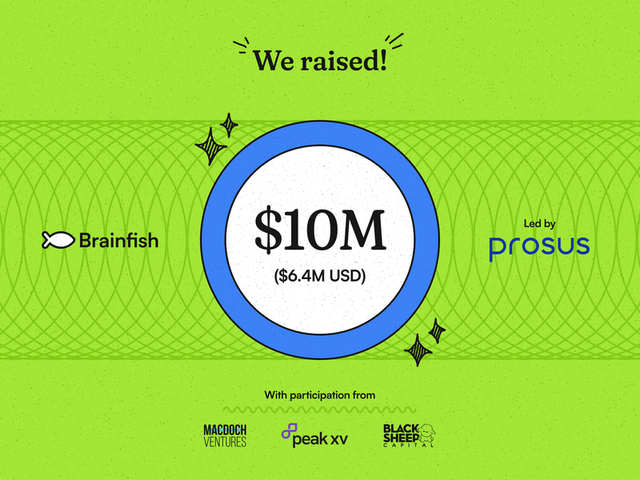 News Brainfish Raises $10M to Define the Future of Customer Support with Ambient AI Customer support teams are stuck in an endless cycle of reacting to the same problems while product teams build features in the dark, waiting for frustrated users to tell them what's wrong. What if instead of handling tickets after users get stuck, your product could prevent those problems from happening in the first place? Brainfish's $6.4M funding round is proof that ambient AI can transform how companies think about customer experience entirely, moving from reactive support to proactive prevention that makes products naturally easier to use. B Brainfish team Read article
  Posts We Asked a Veteran CX Leader What's Wrong with AI Support Today. Her Answer Surprised Us. Looking to cut through the AI hype and understand what customer experience leaders actually need? Our conversation with veteran CX leader Lauren Volpe, CCXP, reveals a stark disconnect between what vendors are selling and what frontline teams are experiencing. While conferences overflow with "revolutionary" AI solutions promising ticket deflection, CX leaders are struggling with overlooked fundamentals like legacy system integration and change management. D Daniel Kimber Read article
  Posts The Real Cost of Building vs. Buying AI Support Every day you debate build vs. buy, your users drown in ticket chaos, your support team is overwhelmed, and engineers build chatbots instead of features. D Daniel Kimber Read article
  Posts Five AI Agents to Complement Your CX team Explore five AI agents that augment your CX team, from intelligent triage and auto-resolution to real-time agent assist and proactive outreach, without replacing human judgment. D Daniel Kimber Read article
  Posts Ambient AI Will Make Manual Knowledge Base Maintenance Obsolete in 2026 Ambient AI makes manual knowledge base maintenance obsolete by auto-updating docs from real user behavior. See how SaaS teams eliminate documentation overhead for good. D Daniel Kimber Read article
  Posts Beyond 7 Steps: How API Actions Automates L2 Support Tasks Without Expanding Your Team Your users don't want instructions. They want results. Research shows support teams handle an average of 21 tickets daily, many getting stuck in the cycle of repetitive explanations while users abandon complex tasks halfway through. But what if there was a better way? Brainfish API Actions bridges this "execution gap" by connecting directly to your systems to complete tasks for users, not just explain them. D Daniel Kimber Read article Posts Ambient AI Agents are the Future of CX and Support AI in customer support is evolving beyond reactive chatbots to ambient intelligence that works proactively in the background, observing user behavior and providing help exactly when needed, without being asked. Like a modern video game that learns and adapts to your play style, this new paradigm makes products naturally intuitive while dramatically improving metrics from self-service rates to NPS scores. D Daniel Kimber Read article
  Posts Help Doc Debt: 80% of Knowledge Bases are Out of Date Did you know only 1 in 5 companies rate their knowledge base as "very accurate"? SaaS leaders are drowning in help doc debt, spending up to 8.5% of revenue maintaining help content that fails to serve users effectively. This article unpacks the hidden costs of outdated documentation, showing how traditional knowledge bases create frustrating "context breaks" and erode user trust. Discover how self-generating knowledge bases are transforming support by automatically creating accurate content based on real user behavior, delivering ROI through reduced support costs, improved NPS, and faster onboarding. J Justin Gabriel Read article
  Posts The Chatbot Graveyard: Why Most Self-Service Fails (And How to Fix It) 90% ticket deflection!" The sales rep proclaimed proudly, not realizing that number was a glaring red flag. When you're drowning in support tickets, that kind of automation sounds like salvation, but if your AI is handling that many tickets, you probably have a bigger problem on your hands. The uncomfortable truth is that most chatbots are failing (spectacularly) and turning products into digital mazes that frustrate users and make everyone a little more skeptical about AI in customer support. - Daniel Kimber, CEO, Brainfish D Daniel Kimber Read article
  Posts Beyond Deflection: How AI Actually Helps Support Teams Work Smarter 90% ticket deflection!" sounds impressive, until you realize it's missing the point entirely. In our race to reduce support tickets with AI, we've forgotten what actually makes customer support valuable in B2B – helping users get important work done. We've watched this play out in companies everywhere, and the most successful ones aren't focused on deflecting tickets at all. They're using AI to understand why their power users rarely need help in the first place, creating experiences so natural that support becomes almost invisible. - Daniel Kimber, CEO, Brainfish D Daniel Kimber Read article
  Posts The Silent 96%: What Your Users Never Tell Support Ever notice how users who actually complain are just the tip of the iceberg? For every person who reaches out to support, 25 others are quietly giving up, finding messy workarounds, or worse...deciding your product isn't worth the hassle. The real kicker is that these silent struggles leave traces like that shiny new feature everyone seemed excited about but mysteriously stopped using. Thing is, we've been so focused on deflecting support tickets that we're missing these quiet signals of users slowly drifting away. D Daniel Kimber Read article
  Posts What We Learned from Analyzing 1M Support Interactions: Patterns That Matter When users need help, they rarely write perfect questions - often typing just a single word like "delivery?" Our analysis of one million support interactions revealed patterns about how people actually seek assistance and what it takes to truly help them. D Daniel Kimber Read article
  Posts Stop Building Walls: Why Self-Service Should Feel Natural Traditional self-service often creates barriers between users and help, focusing on deflection over experience. Self-service with Brainfish, by contrast, anticipates needs, preserves context, and feels like a seamless part of the product. The result? Higher satisfaction, deeper product adoption, and better use of support resources. The key is building paths, not obstacles. D Daniel Kimber Read article
  Posts The Future of Personalized Learning: How AI is Revolutionizing Enterprise Product Adoption AI-powered personalization is revolutionizing enterprise product adoption. Discover how to accelerate onboarding, improve user engagement, and reduce support costs. Learn why AI is the future of tailored product education and how it's transforming the user experience across industries. D Daniel Kimber Read article
  News The $90 billion race to supercharge customer service with AI Capital Brief: The customer service software industry is both large and uniquely ripe for AI disruption. Australian startups like Brainfish are hoping to do just that. D Daniel Kimber Read article
  Posts Boosting Business Support Efficiency: How Brainfish Accelerates Response Times Strategies, tools, and best practices to speed up business support and ensure your customers are heard swiftly and effectively. D Daniel Kimber Read article
  Posts Enhancing Call Center Software by Integrating AI Search AI technology has improved call centers, turning them into sophisticated hubs that respond to customer needs and anticipate them. Through advanced tools like Brainfish's AI-powered search, call centers can offer faster, more accurate support and elevate the customer experience. D Daniel Kimber Read article
  Posts How Brainfish AI Meets the Evolving Customer Support Responsibilities In this article, we look at how Brainfish can help brands reduce their workload and optimize their processes with the help of AI. D Daniel Kimber Read article
  Posts The Impact of Call Center Software on Small Business Success Call center software plays an essential role in small businesses' success. Investing in the right call center software enhances customer experience, operational efficiency, productivity, and valuable insights. This article will review the top 10 call center software options and help you determine which one best meets your needs. D Daniel Kimber Read article
  Posts AI-Powered Support: Best Practices for a Customer-Centric Approach If you're wondering how AI can transform your customer support into customer care, consider this: It's not just about speed and efficiency. AI brings a level of intelligence and understanding to customer interactions that's more attuned to your customers' individual needs and preferences. D Daniel Kimber Read article
  News Australian start-up Brainfish raises $3.85M in seed funding round to redefine customer support experience with AI Brainfish is redefining how information about a product is collated, maintained, and articulated to customers - all in seconds. The new funds will be used to expand to new markets and further build out Brainfish’s suite of services for online businesses. B Brainfish team Read article
  Posts The Art of AI-Enhanced Customer Interactions with Brainfish In customer service, Generative AI stands not just as a tool, but as a catalyst for innovation in customer interactions. As we’ve explored, this advanced technology brings to the table an unparalleled ability to understand, respond, and adapt to customer needs in real-time–redefining the dynamics of customer interactions. D Daniel Kimber Read article
  Posts Striking the Perfect Balance: How Brainfish Merges Automation with Personalization in Help Desks Your brand needs to blend personalization with automation's efficiency to stand out. If you're looking to incorporate this in your customer support, we invite you to book a demo with Brainfish and experience firsthand how our AI can transform your help desk. D Daniel Kimber Read article
  Posts Comparing Business Messaging Channels: Brainfish's Edge Over Chatbots Expectations around business messaging have undergone a dramatic shift. Customers crave choice, speed, and the touch of human interaction, even amidst the advances in AI and chatbots. D Daniel Kimber Read article
 Want to see this in your stack?
Bring 10 of your trickiest tickets, we'll show you the answer Brainfish would have shipped.
Book a demoNo engineering sprint required.